
“I do believe in the power of story. I believe that stories have an important role to play in the formation of human beings, that they can stimulate, amaze and inspire their listeners.”
– Hayao Miyazaki
This is the first volume of a planned monthly series looking at the varied and wonderful works of one of my favorite studios in world cinema; Studio Ghibli. The first review of which being The Little Norse Prince. Founded in June 1985 by filmmakers Hayao Miyazaki and Isao Takahata, the company has since gone on to create and produce the most critically acclaimed Japanese anime movies of all time; eight of which currently rank amongst the 15 highest-grossing anime films of all time, with their masterpiece Spirited Away ranking at number one, having grossed almost $300 million worldwide.
Hayao Miyazaki has gone on to direct, write and produce the majority of Studio Ghibli’s feature-length films, and is today regarded as the Walt Disney of Japan, having garnished critical acclaim for his many works such as Kiki’s Delivery Service, Ponyo, My Neighbour Totoro, and Howl’s Moving Castle to name but a few. His co-founder, Isao Takahata, has also directed several of their most critically prominent releases, such as Pom Poko, The Tale of the Princess Kaguya, and Grave of the Fireflies. This feature will eventually cover all of Studio Ghibli’s films, from Nausicaa of the Valley of the Wind to the upcoming feature When Marnie Was There. Still, the first three features will be dedicated to three films that Hayao Miyazaki and Isao Takahata worked on before the company’s official founding.
The first of these three features was a relatively unsuccessful, yet highly influential anime film entitled The Great Adventure of Horus, Prince of the Sun; or as it was entitled overseas, The Little Norse Prince. The Little Norse Prince took almost three years to create, with production starting in the Autumn of 1965, and finally completed by March of 1968, and going on to be released theatrically in Japan four months later in July. The film is considered influential amongst anime fans since it introduced many different and new elements to the medium and proposed the idea that adults can enjoy them as much as children. Elements that were portrayed in the film included political, social, and mature themes and subjects as well as stylized violence; which made me surprised that the film only received a U rating in the UK. Like many of Studio Ghibli’s later works, which this film would go on to inspire, it features themes such as children coming of age and the suffering of loss; universal elements that Miyazaki and Takahata have used many times to strike as much of a chord with audiences as possible.
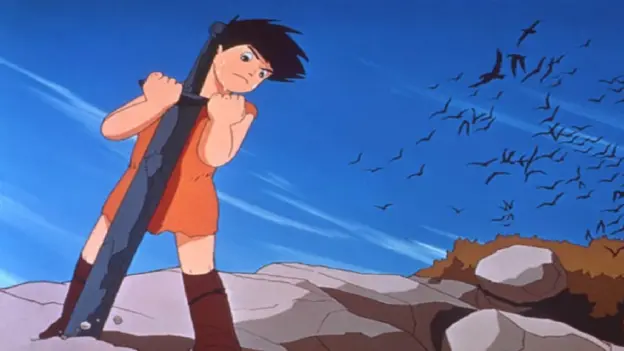
The story of the Little Norse Prince follows a young boy named Hols, who during infancy, had his town attacked by the evil and tyrannical frost king Grunwald. Raised by his father, who fled along with Hols amidst the chaos, he one day encounters a stone giant named Mogue after being chased by a pack of silver wolves. Hols notices that Mogue has an object stuck in his shoulder, and investigates to find that it is a sword, which Hols subsequently removes. Mogue tells Hols that once the sword has been reforged, and when Hols can properly wield it, he will visit him again, and Hols will be proclaimed prince of the sun.
At the behest of his father, Hols and his pet anthropomorphic bear Coro resolve to travel back to their home village and confront Grunwald. However, they come across another village, which has been recently attacked by the frost king, and after earning their trust and being excepted into their populace, the villagers become concerned when Hols befriends a young girl named Hilda, who gradually reveals a deep and dark secret to Hols and the rest of the village.
Relying on a turbulent atmosphere, that goes from delightfully charming and innocent to being compellingly dark and gritty, as well as making use of some particularly well-drawn scenery and environments (something that would become synonymous with Studio Ghibli films), I was quite impressed with The Little Norse Prince overall. It also made me quite surprised that it received such a poor reception even in Japan; let alone in other regions. It has also become so obscure that I was extremely lucky to have picked up a copy in a local shop as opposed to taking to the Internet to buy it, as the version I picked has also since gone out of print following its DVD localization back in 2005; almost 40 years after the film’s original theatrical release in Japan.
Locations in the film that stood out to me in particular as being excellent examples of scenery were the Lost Woods, where the film takes its darkest twist, with Hols suffering eerie hallucinations of Hilda and the villagers. The abandoned fishing town where Hols first meets Hilda was also very well crafted and presented in my opinion, with it most likely being a site of great destruction at one time, now a calm and tranquil place. Seemingly to fit how the character of Hilda is being portrayed when the audience is first introduced to her.
The biggest gripes I had with The Little Norse Prince film were with a feeling of abruptness towards the end, as well as one scene in particular coming up to its mid-point. When the silver wolves are attacking the village for the first time, there is next to no animation, but rather a compilation of still drawings, which to me personally suggested an element of laziness on the animator’s part. Another similar scene occurs later on when a hoard of rats attacks the village, but this scene is also interspersed with animations of the rats running, so there is a little bit more to it than the previous scene. It would have been a good idea if the animators had chosen to apply the same technique to the scene of the first attack on the village if only to keep things consistent. Feelings of abruptness stem from a sudden change of atmosphere, with things going from experiencing a sense of hopelessness to a feeling of sudden and complete projection of empowerment on Hols and the village in a matter of less than ten minutes. I believe if the creators had chosen to draw out one of those two atmospheres a little while longer, then I think the transition would have been a lot more believable than what it turned out to be.
However, despite what criticism I’ve levied against this film, I still enjoyed The Little Norse Prince for its dips in the atmosphere, its stylized fight scenes, and the creator’s willingness and bravery to push what they could get away with in a cartoon film primarily aimed at young children, and to use this technique to also appeal to a more mature audience in the process. The level of obscurity that this film has garnished over the years is nothing short of critical in my opinion. It’s a silently influential film, which allowed both Hayao Miyazaki and Isao Takahata to further advance within the industry, and go on to produce some of the best anime films of all time. The film is emotionally charged, has a powerful atmosphere, and is one of Takahata’s better works to date in my opinion.
7/10